

Best AI Image-to-Video Generators 2026, Tested on a Real Music Video Shot
The best AI image-to-video generators in 2026 for music videos are Kling 4.0 for detailed cinematic hero shots, Seedance 2.5 and Kling 4.0 for long single takes (both go up to 30 seconds), MiniMax H3 Max for value and speed, and Seedance 1.0 Pro Fast for cheap drafts. We ran the same keyframe and the same motion prompt through nine models on fal.ai on November 27, 2026, and every one of them followed the camera move and kept the singer recognizable. The real differences are price, speed, clip length and how much the model "performs". In Neural Frames, these models cost from 4 to 33 credits per second of video. That is about $0.04 to $0.30 per second on the annual Neural Ninja plan.
Key takeawaysAll nine models handled a slow push-in on a singer without broken hands or a melting microphone in the frames we checked. One take per model is not a benchmark, so treat this as a side-by-side look, not a ranking by score.Speed varied a lot on the same day: MiniMax H3 Max returned a 5-second 1080p clip in about 9 seconds, and Kling 4.0 took about 4 minutes.In Neural Frames, the cheapest video model (Seedance Pro Fast) costs 4 credits per second and the most expensive (Seedance 2.5) costs 33. A full 3-minute video costs $10.56 to $58.41 in credits on Neural Ninja (annual), keyframes included.When our users switch away from the default video model, the model they switch to most often is Seedance 1.5 Pro (38.5% of 47,292 switches in 90 days), followed by Seedance 1.0 Pro Fast (13.7%) and Seedance 2.5 (12.3%).Sora is gone: OpenAI says the Sora product has not been available since April 26, 2026. Google's Veo 3.1 preview in the Gemini API shut down on October 22, 2026, and Google now points developers to Gemini Omni Flash.
How we tested
We wanted to answer one question: if you give each model the same starting image and the same instruction, what comes back?
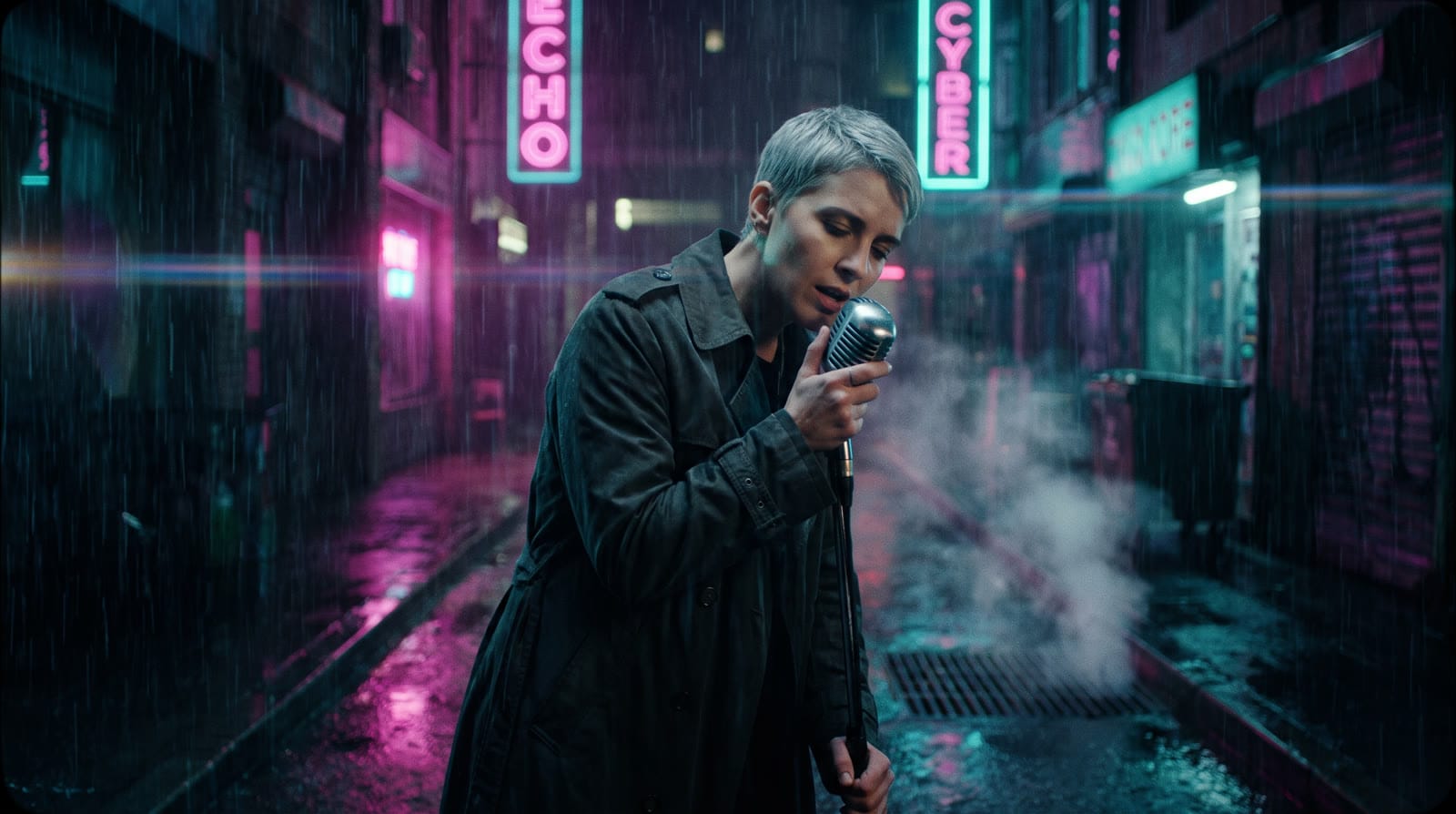
- The keyframe. A single 16:9 image of a fictional silver-haired singer with a chrome microphone in a rainy neon alley, with steam rising from a grate. We made it with Nano Banana Pro. The image has rain, steam, neon reflections, a face, a hand and a metal object, so it shows most of the ways image-to-video goes wrong.
- The prompt, identical for every model: "Slow camera push-in toward the singer as she sings with emotion into the microphone, swaying gently. Rain keeps falling, steam drifts from the grate, neon signs flicker softly. Cinematic, realistic motion."
- The settings. 5 seconds (6 seconds for Veo 3.1 Fast, its nearest option), 1080p where the endpoint offered it, generated audio off, everything else default. One take per model, no cherry-picking.
- Where. All clips ran through fal.ai's API on November 27, 2026. The times below are fal's processing times for our request. The endpoints we used are listed at the end of the post, so you can repeat the test.
This is one shot, one prompt and one take each, so luck plays a part. Settings inside Neural Frames (resolution, duration, prompt handling) can differ from the raw API, so your results in the app may look different.
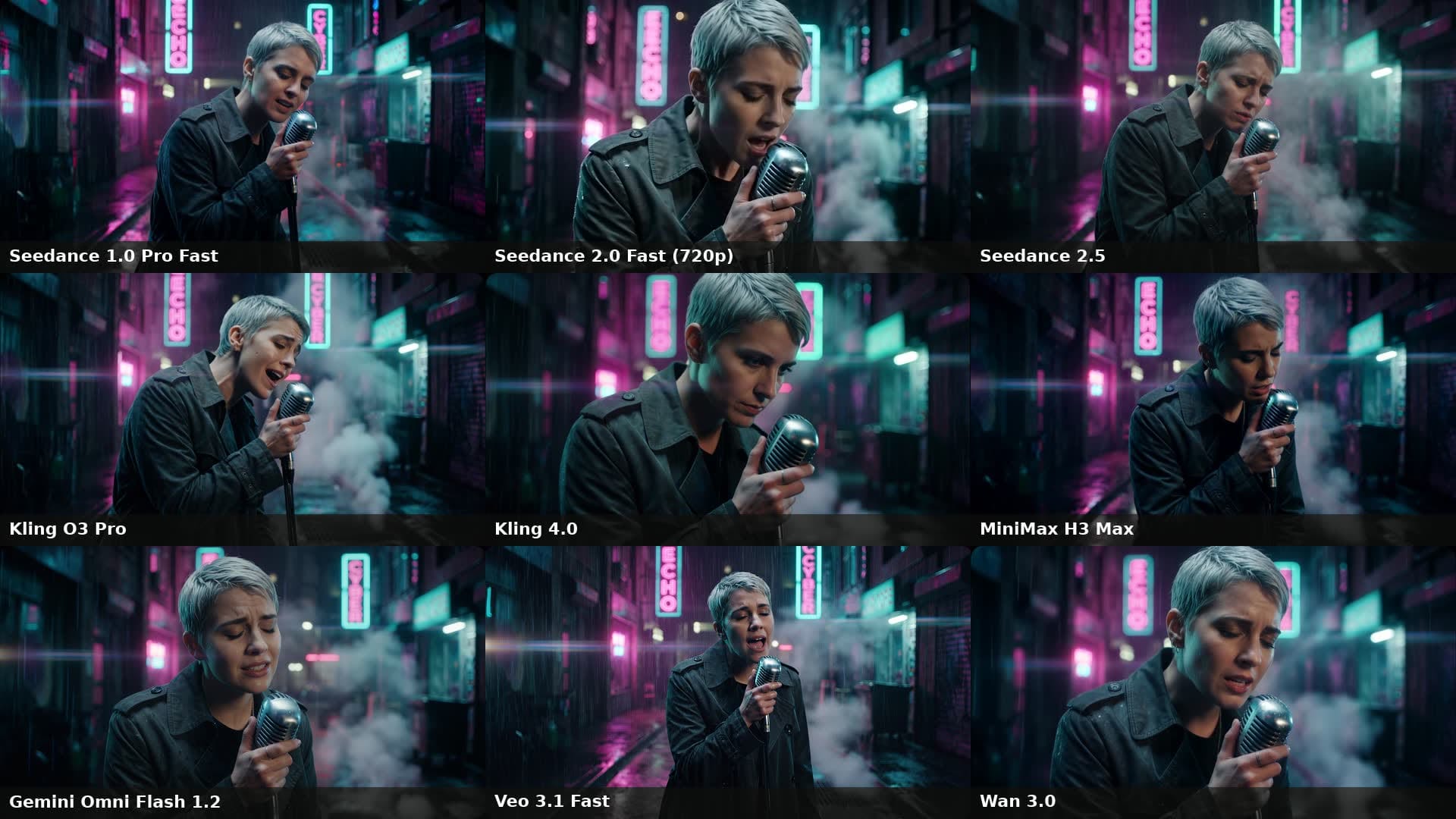
Here are the last frames of all nine clips, so you can see how far each camera moved:
Comparison table
| Model | In Neural Frames? | Max single clip | Max resolution | Neural Frames credits / second | Our test: time on fal | Share of switches to it* |
|---|---|---|---|---|---|---|
| Seedance 1.0 Pro Fast | Yes ("Seedance Pro Fast") | 12 s | 1080p | 4 | 46 s | 13.7% |
| MiniMax H3 Max | Yes | 15 s | 1080p on fal (H3: 768p, 2K via regenerate) | 7 | 9 s | 9.2% |
| Gemini Omni Flash 1.2 | Yes | 15 s | 4K | 12 | 69 s | 4.5% (version 1.1) |
| Kling O3 Pro (Kling 3.0 Omni) | Yes | 15 s | 4K | 16.2 | 101 s | 5.8% |
| Kling 4.0 | Yes | 30 s | 4K, HDR | 17 | 244 s | 5.3% |
| Seedance 2.0 | Yes ("Seedance 2") | 15 s | 4K (Fast version: 720p) | 28 | 175 s (Fast, 720p) | not in top 7 |
| Seedance 2.5 | Yes | 30 s (extendable) | 4K | 33 | 98 s | 12.3% |
| Veo 3.1 Fast | No | 8 s | 4K | n/a | 111 s | n/a |
| Wan 3.0 | No | 30 s | 1080p | n/a | 130 s | n/a |
*Share of the 47,292 times Neural Frames users switched their video model in the 90 days to November 27, 2026. This counts switches to a model. The default model is not counted, because people who keep it never switch. Seedance 1.5 Pro had the largest share (38.5%) but is not on the current pricing calculator, so it is not in this table. Kling 4.0 launched on October 15, 2026, so it was available for only part of the window.
Specs come from each vendor's documentation or the fal model page (sources at the end). Max clip length is for one generation; you can make longer videos by chaining clips.
Cost per second in Neural Frames
Every Neural Frames plan gives you a fixed number of credits per month. The cost per credit is the plan price divided by its credits, assuming you use them all (Neural Knight: 2,400 credits for $39/month or $26/month billed annually; Neural Ninja: 7,200 for $99 or $66; Neural Nirvana: 24,000 for $299 or $199, per our pricing page).
| Video model | Credits / s | Knight monthly | Knight annual | Ninja monthly | Ninja annual | Nirvana monthly | Nirvana annual |
|---|---|---|---|---|---|---|---|
| Seedance Pro Fast | 4 | $0.065 | $0.043 | $0.055 | $0.037 | $0.050 | $0.033 |
| MiniMax H3 Max | 7 | $0.114 | $0.076 | $0.096 | $0.064 | $0.087 | $0.058 |
| Gemini Omni Flash 1.2 | 12 | $0.195 | $0.130 | $0.165 | $0.110 | $0.150 | $0.099 |
| Kling O3 Pro | 16.2 | $0.263 | $0.175 | $0.223 | $0.149 | $0.202 | $0.134 |
| Kling 4.0 | 17 | $0.276 | $0.184 | $0.234 | $0.156 | $0.212 | $0.141 |
| Seedance 2 | 28 | $0.455 | $0.303 | $0.385 | $0.257 | $0.349 | $0.232 |
| Seedance 2.5 | 33 | $0.536 | $0.357 | $0.454 | $0.303 | $0.411 | $0.274 |
That is the video render only. Each clip also needs a starting image (keyframe). The pricing calculator counts keyframes at 2.4 credits per second of song with the default image model. For a 3-minute song on Neural Ninja (annual), keyframes plus video come to $10.56 with Seedance Pro Fast, $15.51 with MiniMax H3 Max, $23.76 with Gemini Omni Flash 1.2, $30.69 with Kling O3 Pro, $32.01 with Kling 4.0, $50.16 with Seedance 2 and $58.41 with Seedance 2.5. The full math, and how this compares with a filmed video, is in How Much Does a Music Video Cost in 2026?
The models, one by one
Kling 4.0: best for detailed cinematic hero shots
What we saw. Kling 4.0 made the biggest camera move of the group. It ended in a tight close-up with very detailed skin, hair and microphone grille. The steam and rain stayed natural. It took the "sing with emotion" part less literally: by the end, the singer's mouth was closed and she looked down at the mic. It was also the slowest model in our run, at about 4 minutes.
Specs. Kuaishou launched Kling 4.0 on October 15, 2026. It makes 3 to 30 second clips at 720p, 1080p or 4K, with 10-bit HDR at 1080p and 4K, in 21:9, 16:9, 1:1 and 9:16. It accepts up to 10 keyframes and up to 15 reference assets, and Kling says camera moves such as push-ins and orbits are stronger than before.
Best for: the shots people will screenshot, such as the chorus close-up or the opening frame, and long single takes. Limits: slow, and 17 credits per second adds up over a full song.
Kling O3 Pro (Kling 3.0 Omni): best for expressive performance
What we saw. The most "performed" clip of the test. The singer opened her mouth and sang through the shot, the push-in was moderate, and the steam billowed far more than in other clips. If you want a vocalist to look like they are mid-chorus, this one got closest without audio. It finished in about 100 seconds.
Specs. Kling 3.0 Omni (called Kling O3 on fal and in Neural Frames) makes 3 to 15 second clips at up to 4K, in 16:9, 1:1 or 9:16, with native audio, multi-shot generation and "Elements" for keeping characters consistent.
Best for: performance shots and anything with visible emotion. Limits: busier atmospheric effects (the steam took over part of the frame in our clip), and it costs almost as much as Kling 4.0.
Seedance 2.5: best for long single takes and heavy referencing
What we saw. A gentle, controlled push-in with an emotional, eyes-closed performance and little drift from the keyframe. It was the most restrained motion of the premium models. The file fal returned was much smaller than the others at the same resolution (about 1.5 MB, versus roughly 7 to 17 MB for the other 1080p clips), so check fine detail like rain streaks if you plan to show the clip large.
Specs. ByteDance released Seedance 2.5 on July 31, 2026. It makes up to 30 seconds in a single pass (up from 15 in Seedance 2.0) and can extend a clip twice. It accepts up to 30 images, 10 videos and 10 audio clips as references. fal offers it at 480p, 720p, 1080p and 4K.
Best for: long takes where you need many references to stay on model. Limits: the most expensive model in Neural Frames at 33 credits per second.
Seedance 2.0: strong motion, but check the safety filter
What we saw. On fal, the standard Seedance 2.0 endpoint declined our keyframe: its safety system flagged the request within 7 seconds and produced nothing. The Fast version of Seedance 2.0 accepted the same image. It only goes up to 720p, and it made one of the strongest push-ins of the test, ending in a close-up of the singer mid-note. It was the second-slowest job at about 3 minutes. If a model rejects a realistic face, try a different model rather than rewording the prompt again and again.
Specs. fal lists Seedance 2.0 at 4 to 15 seconds and 480p to 4K; the Fast version offers 480p and 720p.
Best for: dynamic camera moves when Seedance 2.5's price is too high. Limits: in Neural Frames it costs 28 credits per second, close to Seedance 2.5.
Gemini Omni Flash 1.2: best for big camera moves and first-to-last-frame shots
What we saw. The biggest overall change between the first and last frame. It pushed in until the singer filled the frame, with clear singing and soft, believable steam. It finished in about 70 seconds.
Specs. Google released Gemini Omni 1.2 Flash on November 5, 2026, and says it is 30% cheaper than 1.1. It makes 3 to 15 second clips at 360p up to 4K at 24 fps with native audio, and can interpolate between a first and last frame for 3 to 10 seconds. Google says fast sports action and complex physics are still being improved.
Best for: dramatic push-ins and shots where you control both the start and end image. Limits: 12 credits per second sits in the middle of the range; check fast dance moves before you commit a whole song to it.
MiniMax H3 Max: best value and the fastest model we tested
What we saw. A clean push-in and lean toward the microphone with good detail, returned in about 9 seconds, far faster than anything else. The singer's face was partly covered by the mic at the end, which is natural but worth knowing if you need the face visible.
Specs. MiniMax released H3 on July 31, 2026 and published open weights on August 3. H3 makes 4 to 15 second clips at 768p by default (shorter side) at 24 fps, with 2K through its regenerate step. "H3 Max" on fal is fal's own post-trained version of H3; we rendered it at 1080p.
Best for: fast iterations, previews and full-song budgets. Limits: less "acting" than Kling O3 Pro or Veo.
Seedance 1.0 Pro Fast: best for cheap drafts
What we saw. A calm, subtle push-in and gentle sway, with the scene held together well. It is less dramatic than the newer models, but nothing broke. It finished in about 46 seconds.
Specs. fal lists Seedance 1.0 Pro Fast at 2 to 12 seconds and up to 1080p.
Best for: first passes, B-roll and long songs on a small plan. At 4 credits per second it is the cheapest video model in Neural Frames. Limits: less expressive faces and smaller camera moves.
Veo 3.1 Fast (not in Neural Frames)
What we saw. A clear push-in, visible rain, and the singer singing with her mouth wide open, so it was one of the most convincing performances. It took about 110 seconds.
Specs. fal lists Veo 3.1 Fast at 4, 6 or 8 seconds and 720p to 4K. Google shut down the Veo 3.1 preview in the Gemini API on October 22, 2026 and now points developers to Gemini Omni Flash or its enterprise platform.
Wan 3.0 (not in Neural Frames)
What we saw. A strong push-in to a close-up with an emotional face and steady steam. It was the only clip that came back at 30 fps. It took about 130 seconds.
Specs. Alibaba's Wan 3.0 makes 2 to 30 second clips at 480p, 720p or 1080p, with native audio, an optional pinned first and last frame, and up to 10 images, 5 video clips and 5 audio tracks as references.
Not tested: Runway Gen-4.5 and Sora 2
- Runway Gen-4.5 makes 2 to 10 second clips at 720p (24 or 25 fps), at 12 Runway credits per second. Runway's own guide says image-to-video prompts should focus on describing motion, which matches our experience.
- Sora 2. OpenAI's Sora 2 page now says that as of April 26, 2026, the Sora product is no longer available, so we left it out.
Which model for which use case
| You need | Pick | Why |
|---|---|---|
| Lip-sync to your vocals | A lip-sync model, not a plain image-to-video model | Plain image-to-video models animate a mouth but don't match it to your track. In Neural Frames, lip-sync models (OmniHuman and MiniMax H3 Max reference-to-video) cost 11 credits per second. See How to Make a Lip-Sync AI Music Video. |
| Cinematic hero shots | Kling 4.0, then Seedance 2.5 | The most detail and the biggest controlled camera move in our test; both go up to 30 s. |
| A singer who looks mid-performance | Kling O3 Pro | The most expressive singing in our test. |
| Anime or illustrated styles | Decide the style in the keyframe, then test 2 to 3 models | We only tested a realistic shot this round. The look comes mostly from your image model; see how to pick the right image model. |
| Fast drafts | MiniMax H3 Max or Seedance Pro Fast | About 9 s and 46 s per clip in our run. |
| Budget, full-length songs | Seedance Pro Fast (4 credits/s), MiniMax H3 Max (7) | A 3-minute video is $10.56 to $15.51 on Neural Ninja annual, keyframes included. |
| Exact start and end frames | Gemini Omni Flash 1.2, Kling 4.0 | First-to-last-frame interpolation (Gemini) and up to 10 keyframes (Kling 4.0). |
Lip-sync is a big part of real projects: of 147,386 technique selections in Neural Frames in the last 90 days, 22.4% were lip-sync, 65.7% classic image-to-video and 12.0% lyric video.
Image-to-video tips from 381,000 re-renders
In the last 90 days, Neural Frames users re-rendered 168,919 clips a total of 381,209 times. They regenerated keyframes 143,406 times across 78,588 scenes, and saved scene prompts 150,093 times. What that work teaches:
- Fix the image before you pay for motion. The keyframe sets the face, outfit, light and composition. Every model in our test kept what was in the image; none of them fixed what was wrong with it. Regenerate the keyframe until it's right, then animate.
- Write the prompt about motion, not about the picture. The model can already see the image. Describe the camera move, what the subject does and what the environment does (rain, steam, lights). Runway's prompting guide gives the same advice.
- One camera move per clip. "Slow push-in" was understood by all nine models. Stack three moves into five seconds and you leave the model to choose.
- Use your own images when you need control. Our users rendered clips from an uploaded start keyframe 9,973 times, and from an uploaded end keyframe 4,390 times, in the last 90 days. An end frame is the most reliable way to land a shot exactly where the next one starts.
- Keep your character consistent from the start. 35,977 users created a character from photos 71,639 times in the last 90 days, and 56% of them used a single photo. See character-consistent music videos.
- Reverse-engineer a look you like. Drop a frame you love into our free image-to-prompt tool to get a starting prompt for your keyframe.
- Draft cheap, finish expensive. Rough out the whole song with Seedance Pro Fast or MiniMax H3 Max, then re-render the chorus and the hook shots with Kling 4.0 or Seedance 2.5. More prompt advice from our community is in Writing the perfect AI prompts.
How this fits into a full music video
An image-to-video model makes one clip. A music video needs a storyboard of clips (our users' median is 10 scenes per storyboard), cut to the beat, with consistent characters. That is what the AI music video generator does: it plans the scenes from your song, makes keyframes, and lets you choose the video model per clip. For a broader tool comparison, see 10 Best AI Music Video Generators for Creative Control and Neural Frames vs Freebeat. If you only want to animate a single photo, start with How to Animate a Picture. For the history, our 2025 Seedance 1.0 post covers where the Seedance family started.
FAQ
What is the best AI image-to-video generator in 2026?
It depends on the shot. In our side-by-side test of nine models, Kling 4.0 gave the most detailed cinematic close-up, Kling O3 Pro the most expressive singing, Seedance 2.5 and Kling 4.0 the longest single takes (up to 30 seconds), and MiniMax H3 Max the best mix of speed and price. For music videos, most creators use a cheaper model for most scenes and a premium model for the key shots.
Which AI image-to-video model is the cheapest?
In Neural Frames, Seedance Pro Fast is the cheapest video model at 4 credits per second, about $0.037 per second on the annual Neural Ninja plan. MiniMax H3 Max is next at 7 credits per second, about $0.064. The most expensive is Seedance 2.5 at 33 credits per second, about $0.30.
Which image-to-video model is the fastest?
In our test on fal.ai on November 27, 2026, MiniMax H3 Max returned a 5-second 1080p clip in about 9 seconds. Seedance 1.0 Pro Fast took about 46 seconds, Gemini Omni Flash 1.2 about 70 seconds, and Kling 4.0 about 4 minutes. Times depend on server load, so treat these as one day's snapshot.
How long can an AI image-to-video clip be?
For a single generation, Kling 4.0, Seedance 2.5 and Wan 3.0 go up to 30 seconds. Kling O3, Gemini Omni Flash 1.2, MiniMax H3 and Seedance 2.0 go up to 15 seconds, Seedance 1.0 Pro Fast up to 12, Runway Gen-4.5 up to 10 and Veo 3.1 Fast up to 8. Music videos chain many clips, so the full video can be as long as your song.
Can image-to-video models lip-sync to my song?
Not reliably. A plain image-to-video model can make a singer's mouth move, but it does not match the movement to your vocal track. Use a dedicated lip-sync model instead. In Neural Frames, OmniHuman and MiniMax H3 Max reference-to-video do this at 11 credits per second.
Is Sora still available for image-to-video?
No. OpenAI's Sora 2 page says that as of April 26, 2026, the Sora product is no longer available. Google has also shut down the Veo 3.1 preview in the Gemini API (on October 22, 2026) and points developers to Gemini Omni Flash, though Veo 3.1 Fast is still offered through fal.ai.
What resolution do AI image-to-video models make?
Kling 4.0, Kling O3, Seedance 2.5, Gemini Omni Flash 1.2 and Veo 3.1 Fast offer up to 4K. Seedance 1.0 Pro Fast and Wan 3.0 top out at 1080p, MiniMax H3 defaults to 768p with a 2K regenerate option, and Runway Gen-4.5 outputs 720p. Higher resolutions usually cost more and take longer.
How do I write a good image-to-video prompt?
Describe motion, not the picture: one camera move, what the subject does, and what the environment does. Our test prompt was "Slow camera push-in toward the singer as she sings with emotion into the microphone, swaying gently. Rain keeps falling, steam drifts from the grate, neon signs flicker softly." All nine models followed it. Get the keyframe right first, because the models keep whatever is in the image.
Test details and sources
fal.ai endpoints used (November 27, 2026): fal-ai/bytedance/seedance/v1/pro/fast/image-to-video, bytedance/seedance-2.0/us/image-to-video (declined by its safety filter), bytedance/seedance-2.0/fast/image-to-video (720p), bytedance/seedance-2.5/us/image-to-video, fal-ai/kling-video/o3/pro/image-to-video, kling/v4/image-to-video, minimax/h3-max/image-to-video, google/gemini-omni-flash/v1.2/image-to-video, fal-ai/veo3.1/fast/image-to-video, alibaba/wan-3.0/image-to-video. Keyframe: fal-ai/nano-banana-pro.
Model specs:
- Kling 4.0: Kuaishou press release, Kling 4.0 user guide, Kling API capability map
- Kling 3.0 Omni: Kling 3.0 Omni user guide
- Seedance 2.5: ByteDance Seed blog, Seedance 2.5 page
- Seedance 1.5 Pro: ByteDance Seed release post, Cloudflare model docs
- Seedance 1.0 Pro Fast: fal model page
- Gemini Omni Flash 1.2: Google blog, Google AI Studio model docs
- Veo 3.1 shutdown in the Gemini API: Gemini API video docs
- MiniMax H3: MiniMax H3 announcement, open-source announcement
- Wan 3.0: Wan 3.0 on Runway
- Runway Gen-4.5: Runway help center
- Sora 2: OpenAI, "Sora 2 is here"
Related guides
- How to make a music video: the full process, from concept to release
- 60 album cover ideas: ideas with example covers and prompts
- 10 tips for better AI music videos: practical tips for better results
- How to make short-form music videos with AI: vertical clips for Shorts, Reels and TikTok